Motorcycles of N.A.M.T
2010 Buell XB12R Firebolt
This was the last dealer-delivered Buell sold in Australia, and it has never been removed from its delivery crate. Buell took a huge step forward with the release of the XB9R Firebolt in 2002, and subsequently the 1200cc ZB12R in 2004. Many of the innovative patents Erik Buell had taken out were introduced with this model line, including the fuel-in-frame technology, the swing arm used as an oil tank, and the Zero Torsional Load braking system, where the disc was mounted to the perimeter of the rim enabling the wheels to be extremely light. These factors aided Buell's mass centralisation principles and enabled the 'bike to share the dimensions of a 250cc Moto GP 'bike despite being powered by a 1200cc Harley Davidson sportster engine that was worked to produce 30% more power than standard. Just 253 Firebolts were produced for the world market as 2010 models.
1963 MV Agusta 150 Sport RS
In 1959, a new law was introduced in Italy making it illegal to ride on the highway with a bike that displaced less than 150cc. MV Agusta reworked their 125cc lineup to become 150cc motorcycles, this also included a redesign of the lubrication system. The 150 Sport RS was powered by a 150cc single-cylinder air-cooled engine, producing 13 horsepower, and fuelled by a Dell’Orto carburettor. Reviews in magazines of the period recorded a top speed of 71mph, as well as a dry weight of around 100kg. The 150 Sport RS became a standout in its class, offering impressive performance and handling that made it a favourite among riders looking for a fun and reliable ‘bike in a rapidly changing motorcycle landscape. Production of the 150 Sport RS continued until 1969 when it was effectively replaced by the 250B, although this model was larger – aligning with changing buyer preferences of the late 1960s.
1972 Suzuki GT750
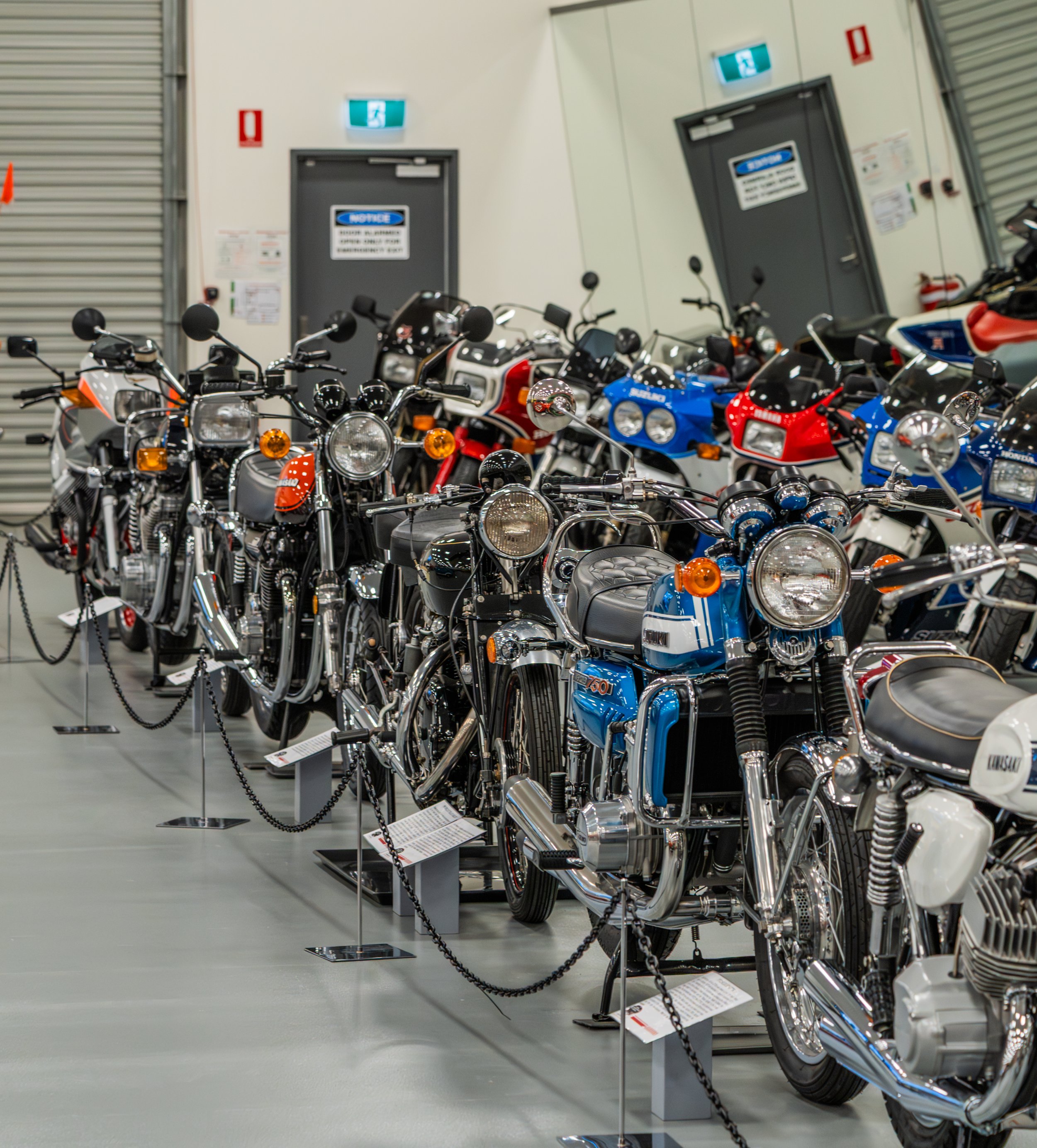
The prototype Suzuki GT750 was shown at the 17th Tokyo Motor Show in October 1970 and launched in Japan in September 1971. The GT standing for Grand Tourismo was marketed as the Le Mans in the US and Canada, it was nicknamed the "Kettle" in Britain, the "Water Bottle" in Australia, and the "Water Buffalo" in the United States. The first model year (1972), the GT750J, had a double-sided, twin-leading shoe, 200 mm drum front brake with 180 mm drum rear. Carburettors were 32 mm Mikuni slide type and power output was 67 bhp at 6,500 rpm. Also included was Suzuki's SRIS (Suzuki Recycle Injection System) which was a method for lowering the visible exhaust smoke by collecting and burning residual oil/gas lying in the bottom of the crank chambers. This was a first for any two-stroke from any manufacturer.
1972 Suzuki GT750
The prototype Suzuki GT750 was shown at the 17th Tokyo Motor Show in October 1970 and launched in Japan in September 1971. The GT standing for Grand Tourismo was marketed as the Le Mans in the US and Canada, it was nicknamed the "Kettle" in Britain, the "Water Bottle" in Australia, and the "Water Buffalo" in the United States. The first model year (1972), the GT750J, had a double-sided, twin-leading shoe, 200 mm drum front brake with 180 mm drum rear. Carburettors were 32 mm Mikuni slide type and power output was 67 bhp at 6,500 rpm. Also included was Suzuki's SRIS (Suzuki Recycle Injection System) which was a method for lowering the visible exhaust smoke by collecting and burning residual oil/gas lying in the bottom of the crank chambers. This was a first for any two-stroke from any manufacturer.
1973 Kawasaki Z1 900
Kawasaki’s Z1 was introduced in 1973, and dominated the superbike arena for much of the decade, with its combination of good looks, power, and competitive pricing. The Z1’s four-cylinder 903cc twin cam engine propelled it to a top speed of 130mph. (208 km/h). Originally designed as a 750, Kawasaki engineers were forced to delay the project after Honda released the groundbreaking CB750. The Z1 became hugely popular, acquiring the nickname ‘The King’. It also earned Kawasaki a priceless reputation for horsepower and reliability. Continual development saw the ‘bike renamed the Z900 in 1976, and a year later capacity was increased to 1,015cc to produce the Z1000.
1987 Honda VFR750R RC30
The legendary VFR750R RC30 was presented for the first time at the Tokyo Motor Show in 1987. With a production limited to less than 5,000 units worldwide, it was conceived following the homologation regulations required to compete in the recently created World Superbike Championship. Handcrafted at the Hamamatsu factory, the RC30 was powered by a liquid-cooled 748cc 90º V4 engine that incorporated state-of-the-art racing technology at the time. It produced 102bhp, and was capable of 239km/h. It had the ability to reach 130km/h in first gear alone. A full factory race kit was available through Honda, containing everything from modified pistons to new camshafts and crankshafts – allowing owners to transform their new RC30s into fully-fledged racebikes. The RC30’s success extended to Australia, where Tasmanian rider Malcolm Campbell claimed the 1989 Australian Superbike Championship aboard the model, further cementing its reputation as a dominant force in production-based racing.
1985 Suzuki RG500 Gamma
Derived from the factory Grand Prix Racer ‘XR45’, the RG500 was a road-legal replica racer produced between 1985 and 1987. To leverage its reputation for producing high-performance racing bikes, Suzuki set out to create a slightly toned-down production model of its competitive two-stroke machine. The result was a ‘bike with a water-cooled square-four, fitted with rotary disc-valve induction and fed by four Mikuni carburetors. The engine produced 95bhp at 9,000rpm, enough to propel the 154kg motorcycle to a top speed of 236km/h. The motorcycle was only available in a blue and white colour scheme, unless it was a rare “Walter Wolf” edition, featuring a paint scheme similar to that of the Wolf Racing F1 cars of the 1970s. The motorcycle on display has travelled just 5,500 kilometres since new. A total of 9,284 units were produced over two years.
1984 Yamaha RZ500
Produced for a very short period of just two years, the Yamaha RZ500 was a high-performance, two-stroke motorcycle built from 1984 to 1986. The ‘bike was marketed as the RZ500 in Australia and Canada, but was instead the ‘RD500LC’ in all other markets. The short-lived model was powered by a 50-degree V4 engine, displacing 499c and producing just under 90bhp. The engine breathes through four side-mounted Mikuni carburettors. As typical for a two-stroke motorcycle of the period, peak power is reached just shy of the 10,500 rpm limit. Interestingly, the model was never officially sold in the United States as it did not meet pollution mandates. In Australia, the RZ500 was a hit on circuits as well as the road, with an RZ500 entered by Richard Scott and Michael Dowson scoring 1st place in the 1984 Castrol Six Hour Event at Oran Park in New South Wales.
1981 Suzuki GSX1100 Katana
The Katana's design started when Suzuki hired Hans Muth, ex-chief of styling for BMW, to update the company's image. The three-man Target Design team consisted of Muth, Jan Fellstrom and Hans-Georg Kasten. In late 1980 when the GSX1100S Katana hit the street, it was claimed by Suzuki to be the fastest mass-production motorcycle in the world, ensuring the new looks were matched by unprecedented performance levels. So radical was the design departure from previous mass-market cycles that most major motorcycle magazines of the era thought the design would not appeal to the masses. Nevertheless, it was a sales success, and the motorcycle had a lasting impact on motorcycle design. The Australian market featured a wire wheel option 18 inch rear and 19 inch front (as displayed) to provide a wider tyre choice for production racing particularly in the Castrol 6 Hour.