1971 Ford Falcon XY GT
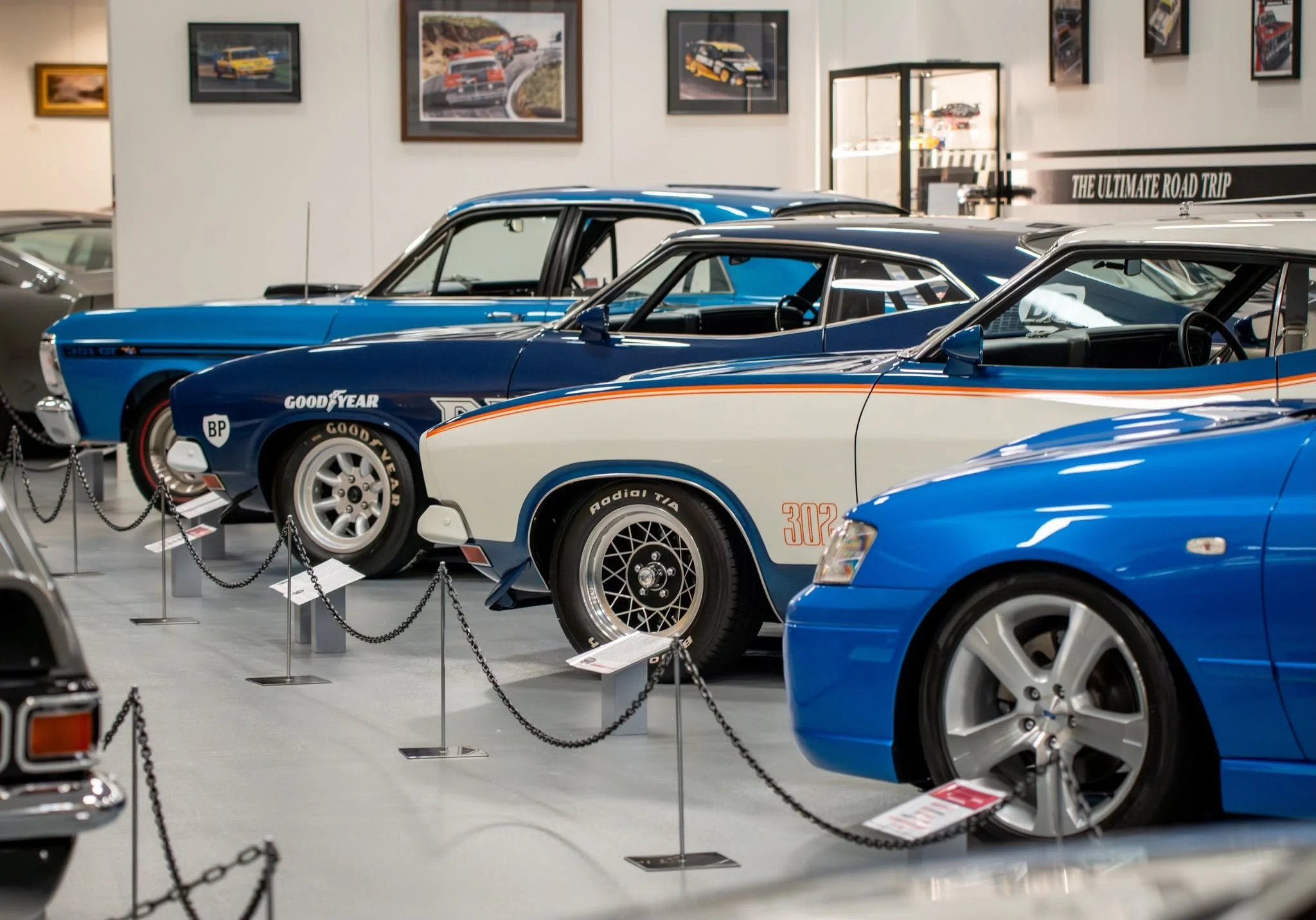
Widely regarded as one of the greatest Australian muscle cars of all time, the XY Falcon GT was launched in November 1970. Ford further enhanced the Cleveland 351 cubic inch (5.8 Litre) V8 by adding a bigger Autolite 600 cfm four-barrel carburetor and raising the compression ratio to 11.0:1. Externally, the XY GT retained the matte black bonnet panels, grille and rear panel and Super Roo decals but introduced the iconic ‘Shaker’ bonnet scoop for the first time. Ford also improved the GT’s braking capabilities by installing bigger Kelsey-Hayes discs up front. The vehicle on display was built in February of 1971 and has had just three owners since new. It has been restored to factory specification of an ‘Electric Blue’ exterior with a black vinyl interior. It was extensively restored by Rodney Plowman Restorations of Adelaide, South Australia.
1974 Ford Falcon XB ‘Brut 33 Tribute’
Allan Moffat OBE was born in Canada in 1939, moving to Australia at age 17, Moffat became an icon of Australian motor racing during the 1970s and 1980s. In the early 1970s, Allan Moffat developed project ‘B52’ – the XB Falcon Hardtop was sent to the United States of America, to be developed and tested at the same ‘Kar Kraft’ premises where the legendary Trans Am Mustang was developed. The vehicle was tested over 2000 kilometres, reaching speeds of over 160mph. On return the car achieved a win at the Sandown 250 in 1974. The vehicle on display was built as a tribute to the car that won at Sandown. At Bathurst the same year he did not have the same success, and after a multitude of engine and gearbox problems he was forced to retire after 92 laps. The car was later repainted into the #25 Thorn Red car. Unfortunately, a transporter fire in Murray Bridge (80 kilometres out of Adelaide) destroyed the car in 1976. Allan Moffat passed away on the 22nd of November 2025. He is remembered as one of the most influential and successful figures in the history of Australian motor racing. The Falcon on display started life as a six-cylinder, automatic Fairmont. It was purchased by the current owner in 2013, in poor condition and requiring a lot of work. He initially intended to use the car for the occasional track day, however once he got the car painted he decided it was too good to risk damaging on the racetrack. The car only competed in one race while wearing the exact livery the owner was replicating (Sandown 250 in 1974), and so extensive research was undertaken to ensure the smallest of details were represented. The vehicle is powered by a 351 Cleveland V8, fitted with 2V heads and 4V valves and roller rockers. An ASR sump and an ICE ignition system, fed by twin side-draught Weber carburettors. It is fitted with race seats, a six-point harness and a bolt-in roll cage
1975 Ford XB Falcon 500 – John Goss Special
In the mid-70s when flared pants, body shirts, platform heels and disco music epitomised groovy youth culture, Ford desperately needed to invigorate its slow selling Falcon hardtop with keener pricing, eye-catching looks and a new market theme to attract younger buyers. The 1974 Bathurst win by Ford privateer John Goss was the catalyst for one of the company’s most successful limited edition Falcons. As stated by John Goss himself “The fact that it wasn’t a GT was the key to its success, it was affordable and it was unusual.” Up to 700 John Goss Falcons were sold in 1975, significantly more than GT sales in both body styles for that year (123 GT Hardtops). The high theft & crash rates of the GT forced insurance companies to wipe their hands clean of the GT, effectively preventing young drivers from buying a GT. No insurance and no finance meant no car! The John Goss Special was fitted with a Cleveland 302 to appease the insurance companies and increase sales. The John Goss Special was distinguished by its white paint with contrasting blue or green bonnet with reflective orange stripes on the guards, rear panel and boot lip. Despite the smaller capacity, the Cleveland 302 still delivered strong V8 performance.
The John Goss Special on display was purchased by the current owner around 20 years ago, as a gift to himself for graduating from the police academy. He had always wanted a hardtop Falcon and this presented the perfect excuse. It had been used as a parts car, riddled with rust and a full respray was required. It is a totally matching numbers car. When he met his soon-to-be wife, he wanted it to be their wedding car and two weeks before the wedding it was a bare painted shell. The owner and a friend finished the car on the day of the wedding. The first time his wife rode in the car was on the way to their wedding, making it all the way from Launceston to Coles Bay without breaking down. It did however break down on the way home, however this was quickly fixed. The interior of the car has been retrimmed by Rex Viney, who trimmed many John Goss Specials and other hardtop Falcons for dealers, offering potential buyers a wide variety of colour combinations, to suit the two-tone scheme on the exterior of the car. In the 20-odd years the car has been owned, the current owner allowed the original owner to drive it on his 70th birthday. Most recently, in March 2025, John Goss took the car for five flat-out laps of Baskerville, marking his first return to the circuit since leaving Tasmania to race in the early 1970s.
2003 Ford Falcon BA XR8 Coupe
The BA Falcon represented a 500 million dollar investment and 24000 hours of engine and durability testing. Germany's Nürburgring test track was used for some suspension testing. Ford never offered a coupe version of its BA Falcon. The car on display was built by Dreamtech a Melbourne based company who specialise in building stretched limousines. The most challenging part of the BA Coupe build was ensuring the side impact protection complied so the car could be registered in any Australian state. The ‘B' pillars have been moved 250mm rearwards, the chassis has been reinforced internally and new doors have been manufactured 250mm longer to suit. New custom door trims, rear trims, windows, weather strips, door rubbers and headlining all had to be produced. The car on display BA Coupe Number One was shown by Dreamtech at the Melbourne International Motor Show in 2003, and was received very positively.
Peter Brock
1945-2006
The National Automobile Museum of Tasmania recognises the incredible contribution Peter Brock had on Australia's automotive story and culture. A special display of four Brock Commodores is now showing in our Hall of Muscle.
From his early success with Holden through to his legendary Bathurst victories, Brock built a reputation for speed, consistency and an extraordinary connection with Australian car enthusiasts. His partnership with Holden Dealer Team (HDT) produced some of the most iconic performance Commodores ever built, including the VC, VH, and VL models, which combined racing influence with road-going performance.
1967 Ford Falcon XR GT
In May 1967, Ford Australia launched the vehicle that started the muscle car war in Australia, the XR GT. Indistinguishable from the standard car at a glance, the XR GT heralded the dawn of Australian motorsport’s golden era. Equipped with full sports suspension, ZA Fairlane bucket seats, and a wood-rim steering wheel, the 289 Windsor V8 was coupled to a four-speed manual gearbox. This gave the XR GT the performance to match its quietly menacing looks. Due to homologation rules in place at the time, the XR GT was launched for general sale to an excited public. In October 1967, however, the reason for the XR GT’s creation became clear when it won the ‘King of the Mountain’ title at Bathurst, setting the benchmark for a new generation of Australian muscle cars.
1970 Valiant VG Pacer
It was Ford that kicked off the power wars of the late-'60s, with the V8 powered XR Falcon GT. Not to be left by the wayside Chrysler Australia released its own low-cost, red-hot version of the Valiant. Featuring a high-performance six-cylinder engine and three-speed manual gearbox, the Pacer was aimed firmly at the youth market, previously ignored by Chrysler. Although lacking the V8 power of its rivals the Pacer could race to 180km/h and, at $2798, was a lot cheaper - $400 less than a basic GTS Monaro. The VG Pacer arrived in 1970 powered by a high-performance, two-barrel version of the new Australian made 245cu.in (4.0-litre), six-cylinder Hemi engine. A 'Mod Pack' comprising black bonnet patches and 'spoiler stripes' was available to spice up the exterior. The car on display has undergone a complete restoration.
1972 Holden Torana LJ GT-R XU-1
The GTR XU-1 had its Bathurst debut in 1970. With promising results in 1970 and 1971, Holden released an updated XU-1 based on the LJ series for 1972. The car on display is a very early 1972 build and is believed to be one of just seven metallic Phantom Grey cars built that year. The first owner purchased this car in South Australia following his retirement. When he passed away, the car was sold in an estate sale, later being repossessed. For most of its life, it was owned by a lady that owned an orange orchard in Adelaide. This Torana has won fifteen shows in total, including Best Muscle Car in Melbourne. It has been signed by Colin Bond, Harry Firth, Peter Brock, Bev Brock, and Ian Tate, and retains all matching numbers.