Main Room
1974 Holden Monaro HQ GTS - Tasman Bridge Disaster
The Holden Monaro was produced between 1968 and 1977 and later between 2001 and 2005. Since its 1968 debut, three generations of the Monaro have been produced. The car on display was involved in the Tasman Bridge disaster on the evening of 5th January 1975 in Hobart, when a bulk ore carrier travelling up the Derwent River collided with several pylons of the Tasman Bridge. The collision caused a large section of the bridge deck to collapse onto the ship and into the river below. Twelve people were killed, including seven crew on board the ship, and the five occupants of four cars which fell 45 metres after driving off the bridge. The disaster severed the main link between Hobart and its eastern suburbs, and is notable for the social impacts that resulted from the loss of such an important road artery. The car on display was left precariously balancing on the edge of the bridge. The car on display remains in original condition.
1948 Holden 48 - 215
On 29 November 1948, 1200 men and women, including Prime Minister Ben Chifley, greeted the first Holden with loud applause. This was a completely new six-cylinder sedan and became the first successfully massed produced Australian car. Buyers boasted of 80 mph and 30 mpg; the dust sealing and ride were exceptional. As the word was passed around, the waiting list for “Australia's Own Car” grew longer and longer. The cars were powered by a 132.5 cubic inches (2,170 cc) inline six-cylinder engine, commonly referred to (due to its paint colour) as a "grey motor". Only 163 cars were built in 1948; this example is Body No. 37, the 37th vehicle produced, and one of the first three to come to Tasmania. The car was first used by the Motors Co. as a Company Car and has been owned by Motors for all bar 9 years of its life. The car was restored by Motors in 1998.
Octopus Test Bench
Dating from the early 1950s, the Octopus test bench allows complete testing of all rotating electrical and ignition components to be carried out with ease.
The Octopus on display was kindly donated by Max & Marilyn Geard.
1909 Renault
Before the turn of the nineteenth century, Louis Renault built a small De Dion-engined device with an unusual shaft drive. In an era when automotive styling and design was in its infancy, Renault products were instantly recognizable by their distinctive ‘shovel’ nose. The example on display was sold new in Tasmania. From humble origins, Renault became highly diversified, building trucks, buses, railcars, and tanks as well as locomotive and marine engines. In 1908 Renault produced its first aero engine, an air cooled V8, and by 1930 was the worlds largest aero engine manufacturer. War proved to be the downfall of Louis. Forced to work under German occupation, he was later imprisoned where he suffered brutal treatment that led to his death. However, the company that bore his name survived, and continues to flourish today.
1958 Messerschmitt KR200
Best known for war-plane construction under the Nazi Regime, Messerschmitt in the post-war years began production of a series of microcars, designed for a recovering German economy. There was a ban on German fighter plane production, leaving Messerschmitt without a product to sell. A German engineer called Fritz Fend penned the design and found a company capable of producing it in Messerschmitt. The KR200 is powered by a Fichtel & Sachs single cylinder 191cc engine, producing a mighty 10 horsepower. Surprisingly, this is enough to propel the 230kg three-wheeler to a top speed more than 90km/h! The KR200 was a mainstay of the ‘Bubble Car’ craze that swept across Europe in the 1950s, a competitor to cars such as BMW’s Isetta, Heinkel’s Kabine and the Peel P50. Today, these cars remain highly collectable amongst enthusiasts.
1987 BMW 333i
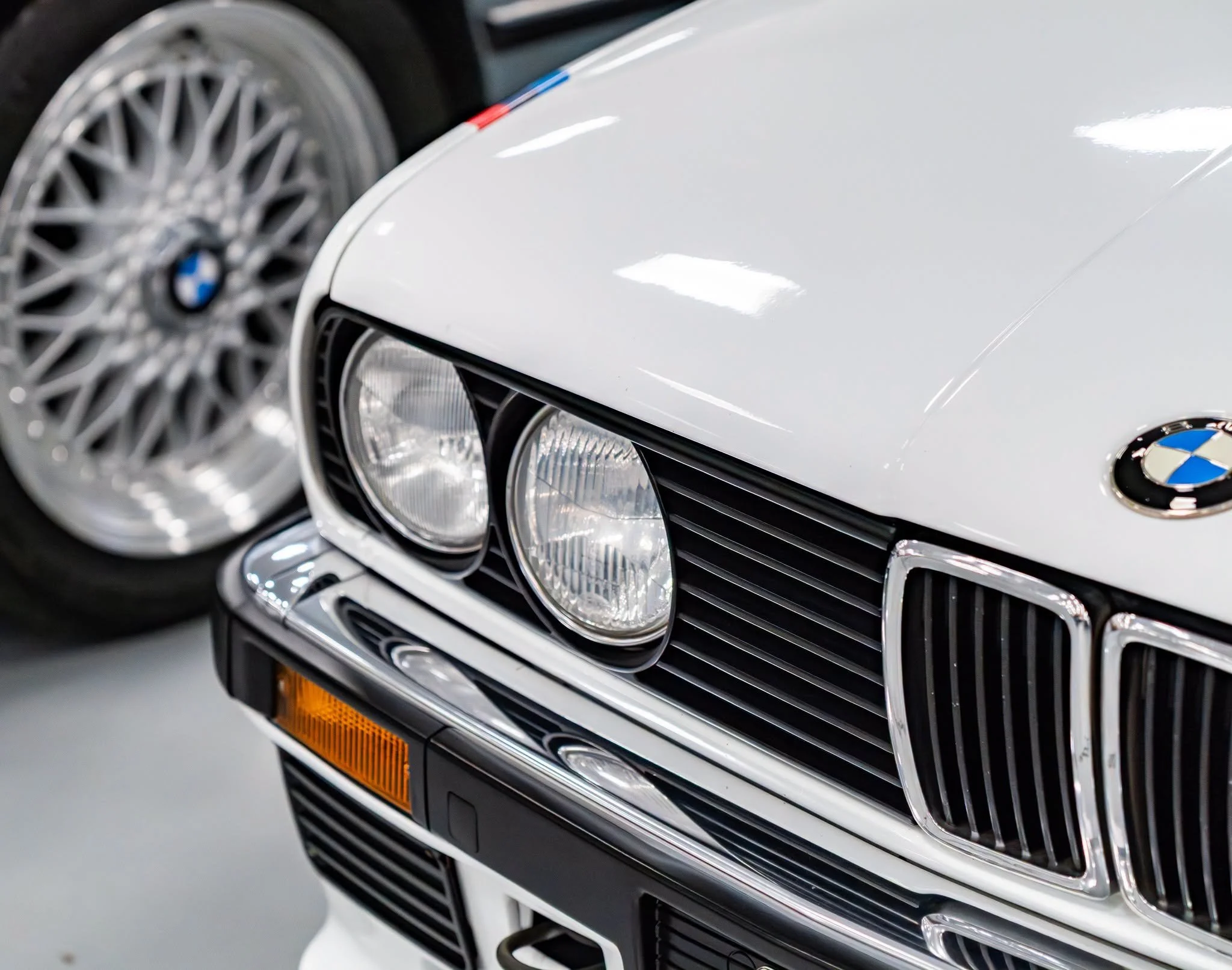
Between 1985 and 1987, BMW of South Africa manufactured a very special 3-Series. It was created to complete in Group 1 saloon car racing, however the class was discontinued in 1985. The concept was straight-forward, find one of the biggest engines available in the BMW parts bin and fit it to the lightest body. The 333i featured the M30B32 six cylinder engine, seen in larger BMW models such as the 533i and 733i. This enabled the vehicle to accelerate to 100km/h in 7.2 seconds and to a top speed of 231km/h. Alpina played a role in the creation of the car, providing a specially developed intake and exhaust manifold. Alpina also provided upgraded brakes, revised suspension and 16-inch 20-spoke alloy wheels. It came fitted with a dog-leg close-ratio gearbox and ZF limited-slip differential. Just 204 were constructed before production ended in 1987.
1936 MG NB
The MG N-type (also known as the MG Magnette) is a sports car that was produced by MG from October 1934 to 1936. The engine was a further development of the 1271 cc 6-cylinder KD series overhead camshaft engine used in the K-type and originally used in the 1930 Wolseley Hornet. Modifications were made to the cylinder block and head and fitted with twin SU carburettor. It produced 56 bhp (42 kW) at 5500 rpm. The NB, announced in 1935, had an updated body with lower lines and vertical slats on the radiator grille. 1936 also saw the addition of a close-ratio gearbox. A total of 98 two-seater NBs were produced before production ended. The NB was capable of speed exceeding 85mph, no small feat in the 1930s. The example on display is supercharged, with a substantial power increase as a result.
1964 Iso Rivolta 300
Iso Rivolta was originally founded in 1939 by Renzo Rivolta in Genoa, Italy, as Isothermos, a company specializing in refrigeration equipment. After World War II, the company shifted its focus to producing scooters and motorcycles under the Iso brand, before eventually entering the automotive industry. One of Iso’s most famous creations is the Isetta, a small, egg-shaped microcar known as the “Bubble Car.” The Isetta was introduced in 1953 and became one of the most recognizable cars of the 1950s. The design was so innovative that it featured a front-opening door that swung open with the steering wheel attached. BMW later bought the license to produce the Isetta, which became a huge success in post-war Europe. The IR 300 was introduced in 1962, fulfilling their goal to create a sportscar. It was fitted with a Chevrolet 327ci (5.3-litre) V8 borrowed from the Corvette, offered with either 300 or 340bhp. Buyers could choose between a four-speed Borg Warner manual transmission, or a two-speed automatic transmission. A five-speed ZF gearbox was offered late into the production run. Like several low-volume manufacturers of the era including Jensen, Iso sourced engines and drivetrains from larger manufacturers, allowing the company to focus on styling, luxury, and performance without the enormous cost of developing their own engines.
The elegant body was designed by the then 20 year-old Giorgetto Giugario, his blending of Italian sophistication with muscular American-inspired styling earned wide praise from the motoring press of the time. The Rivolta’s great handling was provided by a coil-spring suspension setup, with an anti-roll bar in the front, and by a DeDion rear axle with coil springs in the back. Four-wheel disc brakes came standard. It was designed to offer effortless grand touring across the European countryside, with a 100-litre fuel tank fitted. The Rivolta carried a hefty price tag, costing £4360 at a time when a Jaguar E-Type cost a ‘mere’ £1992. For further comparision, an Aston-Martin DB5 was offered for £4248 at the same time. Despite strongly positive reviews from the motoring press and engineering praise, by the time production ended in 1970, a mere 797 examples had been constructed. In the meantime, Renzo Rivolta had passed away in August 1966, leaving his 25-year-old son Piero in charge of the company, which continued to unveil low-production sports cars until 1974 – when the company went bust. The Rivolta on display was campaigned throughout the 1990s and early 2000s by Chris Stephen, in Targa Tasmania and Classic Adelaide amongst other events. It held the Group NB lap record at Symmons Plains in the early 2000s, with a time of 68.38 seconds.
1927 Rolls Royce Phantom I
Chassis No. 18LF
The Rolls-Royce on display was ordered new by Hollywood movie producer Joseph Schenck for his wife, silent film star Norma Talmadge. The car spent many years garaged at the couple’s Hollywood Boulevard mansion and became closely associated with the glamour of the silent film era. This Phantom underwent its initial chassis assembly in the United Kingdom before being shipped to New York, where famed coachbuilder Brewster & Co constructed the body. This is unusual, as most American-bodied Rolls-Royces were assembled entirely in the United States. Beneath the bonnet is Rolls-Royce’s renowned 7.7-litre six-cylinder engine, engineered for smooth, quiet and effortless performance rather than outright speed. The car went on to enjoy a remarkable life in popular culture and entertainment. During the 1920s and 1930s it was linked with the glamorous Hollywood social scene surrounding Norma Talmadge and Joseph Schenck. Beyond its Hollywood ownership, the car has had an extraordinary on-screen life spanning decades. Its earliest known film appearance came in the 1964 production Bikini Beach, where it was driven by a chimpanzee!
That same year, it also appeared in the drama Shock Treatment. In the following years, the Phantom continued to be used in period productions, including Robin and the 7 Hoods, starring Frank Sinatra, Dean Martin and Sammy Davis Jr, amongst others. Alongside its film career, the car also had a striking appearance in the May 1973 issue of Playboy, featuring Anulka Dziubinska scantily clad and posed in the rear seat. Decades later, the car has remained active in major productions. It appeared in the 2008 film Australia, sitting on the streets of bomb damaged 1942 Darwin. More recently, the Phantom was also used in Baz Luhrmann’s 2013 adaptation of The Great Gatsby, where it once again fit seamlessly into the lavish Jazz Age world of Gatsby’s America. Throughout its life, the Phantom has remained a symbol of early automotive opulence. The Brewster coachwork features sweeping lines, fine detailing and a spacious rear compartment designed for chauffeured comfort, reflecting the highest standards of 1920s motoring. These cars were never simply transport, they were bespoke statements of wealth and status, tailored for each individual client.
2009 Rolls-Royce Phantom Drophead Coupé
Rolls-Royce unveiled the Phantom Drophead Coupé at the 2007 North American International Motor Show. It is not merely a Rolls-Royce Phantom with the roof removed – every exterior panel of this convertible is different, from the grille to the boat-inspired teak decked rear. The interior has been designed with the possibility of the elements meeting the materials used in the cabin. The finest quality leather and wood are used throughout the cabin, and the convertible top features five layers of insulation as well as a cashmere lining. Power is provided by a 6.75-litre V12, producing 453bhp and an incredible 720nm of torque. Rolls-Royce had begun work on the Phantom in 2003, under new owners BMW. The Phantom was credited with reviving the Rolls-Royce brand and restoring the British company’s credibility as a renowned manufacturer of luxury cars. Despite the immense weight of 2,620kg, the Phantom Drophead Coupé can reach approximately 149mph, and 0-60mph in just 5.8 seconds.
1988 Porsche 911 Carrera - Backdate
The Porsche 911 was born in 1963 and initially designated the 901, however Peugeot had already reserved three-digit model numbers with a zero in the middle, leading to the change to 911. By 2026, eight generations of the 911 had been produced through continuous evolution. The car on display offers a glimpse across two generations simultaneously. In 2019, a Sydney collector sourced a concours-winning 1988 Carrera Sport Coupe from the United Kingdom, fitted with a 3.2-litre engine and 5-speed G50 gearbox, as the basis for a backdate project. The car was extensively reimagined by Sports Cars Holland into a lightweight tribute to the early 911 S/T, a model produced by Porsche between 1969 and 1971. It is deliberately stripped of modern driving aids, lacking ABS and power steering, with the aim of delivering a purer, more analogue driving experience. While extensively rebuilt over a three-year period, it retains its original engine, gearbox and running gear. “Backdating” a Porsche 911 is a relatively common practice, driven by the appeal of the early cars’ simplicity, lightweight construction and iconic design. For many, this backdated form represents the 911 at its most pure and engaging expression. It features an interior by Porsche resto-modder ‘Singer’, with uncompromising attention to detail.
2018 Aston-Martin Vanquish S
Founded in 1913 by Lionel Martin and Robert Bamford, Aston Martin became globally renowned during the David Brown era, which began in 1947 and gave rise to the famous “DB” models. Under Brown’s ownership the company achieved major racing success — including victory at the 24 Hours of Le Mans — and established the elegant grand touring reputation that still defines the marque today. The Vanquish S is the final evolution of the Aston Martin VH platform, which was introduced in 2002. It was the last naturally-aspirated V12 road car produced by Aston Martin. Denoted by the company as a ‘Super GT’, competitors when new included the Ferrari 812 Superfast and Ferrari F12berlinetta. Powered by a 5.9-litre V12 producing 444 kilowatts (595 horsepower), the Vanquish S is capable of 0–100 km/h in just 3.5 seconds. Top speed is 323 km/h. The VH platform utilised bonded aluminium construction with extensive carbon-fibre body panels, combining strength with relatively low weight. An eight-speed Touchtronic III automatic transmission sends power to the rear wheels, reinforcing its grand touring character rather than outright track focus. Just 532 Vanquish S Coupes were produced, of which 289 were built in right-hand drive and only 25 were delivered new to Australia, making local examples particularly rare and desirable.
1974 Leyland P76
Released in 1973 and packed with advanced features for its time, the Leyland P76 should have taken the Aussie car market by storm. it was intended to provide the company with a genuine rival to large local models like the Ford Falcon, the Holden Kingswood, and the Chrysler Valiant. The P76 had the distinction of winning Wheels Magazine’s Car of the Year in 1973, but the combination of rushed assembly, fuel crisis and strikes at the component manufacturers factories led to it being labelled a lemon, and production ended in early 1975 after just 18,007 had been produced. The P76 was nicknamed "the wedge", on account of its shape, with a large boot, able to easily hold a 44 gallon drum. British Leyland announced plans to sell P76 in the UK. However, production ceased before these plans could come to fruition. The car achieved success in the 1974 World Cup Rally, winning the Targa Florio section and placing 13th overall. Leyland Australia celebrated this victory by releasing a limited edition Targa Florio model: the V8 Super with a limited slip differential, sports wheels and steering wheel, as well as special paintwork, including side stripes. The P76 on display is a factory V8 automatic example and was sold new in Ballarat, before ending up in the current owners possession for around 10 years.
1927 AJS HR7 “Jowett Special”
A. J. Stevens & Co. Ltd was a British automobile and motorcycle manufacturer in operation from 1909 to 1931. The first big-port AJS was released in 1922, the nickname derived from the drainpipe-like exhaust. This 350cc HR7 was initially purchased by Trevor and Wilf Jowett, the AJS Agents for Northern Tasmania. They owned the AJS dealership in Launceston and prepared this bike for speed record setting. During the mid-1930s at Bakers and Greens Beach in Tasmania, this motorcycle set two Australian records for the standing and flying quarter mile with a sidecar and passenger. In solo form and running on alcohol the bike achieved a speed of 97mph on Green’s Beach. It was successful both in beach racing and hill climb events until the mid-1950s. The motorcycle remained in custody of the Jowett family until 1994 and was restored beginning in 2000.
1965 Austin-Healey 3000 Mk III
The Austin-Healey 3000 was produced from 1959 to 1967. The bodywork was made by Jensen Motors. The vehicles were assembled at BMC`s MG works in Abingdon, alongside MG models. The 3-litre 3000 was a highly successful car, it won its class in many rallies in its heyday and is still raced in classic car competitions by enthusiasts today. British Motor Corporation ended manufacture in 1967, intending its place to be filled by a car with a new, though similar, engine in a more recently designed monocoque MGB variant named MGC. Only on sale for less than three years, the 3000 Mark I BN7 remains one of the rarest and most sought after Big Healey variants, with a combined production tally of just 2,825 units, the majority of these sold to North American customers – best estimates for RHD production are just 157 cars. The car on display has undergone a full restoration by the Healey Factory.
1939 BSA Silver Star
This is an incredible story of a motorcycle that survived all these years, its journey through various owners and how it found its way back to a young man, Barry Freeman. This 1939 BSA Silver Star is quite unique and it is greatly sought after by motorcycle enthusiasts around the world. This model was produced in the UK. In 1939 the bike was exported to Australia. 1939 also marked the start of the Second World War, and as a result, Australia only received 45-50 of these Silver Stars. Those that did arrive were quickly recalled by The War Department for use in the war effort. In 1939, the bike was purchased new in Launceston by Tas Laws. In late 1939 the government began acquiring motorcycles to be used in the war effort. Tas Laws decided against this idea and promptly buried the bike in his backyard, wrapping it in heavily oiled canvas to preserve the metal. The bike remained buried until the end of the war, after which it was exhumed and found to be in remarkable condition, with only the exhaust pipes and muffler affected by rust, which Tas replaced with new parts. The bike was then used for daily means of transport by Tas until sometime in 1948 when it was sold to Les Whittle, a neighbour of Tas. The bike was again used for general purpose until sold to a very young 17 year old Alan Freeman. Alan’s family were friends with the Whittles and after many months of pestering by Alan, the bike became Alan’s, much to the delight of his younger brother Barry. Alan put the bike to good use in his work as a travelling salesman, but the relationship with this special machine was not to last, and on July 20, 195, Alan whilst riding the bike collided with a truck and lost his life. after the accident the bike was placed in police storage for a period of almost 12 months. Barry, now 15 years old, used to visit the lockup to view the bike through its cage and reminisced of the the many times he had been with Alan on his country trips, riding pillion. After the release of the bike it was decided by the Freeman family to sell the bike, much to the disappointment of young Barry, who pleaded for one last ride before the sale. The bike was sold for the third time in 1952 where it was used by the new owner for general use before being put ‘on loan’ for educational purposes at a tertiary college in Launceston. Over the years Barry’s career took him interstate and he finally settled on retirement in Adelaide. His love of motorcycles led him to restore numerous classic and vintage bikes, however he was always silently searching for his favourite, a 1939 BSA Silver Star, like the one Alan his brother had owned. On one of his trips to Launceston, in 204, he asked a number of enthusiasts if they might be able to assist him in locating a ’39 Silver Star. One of those enthusiasts, Syd Woodfield, thought he might know of one and offered to ‘check it out’ and returned with a positive answer a few days later. Meanwhile Barry had also had another response from a friend of the family and both contacts although completely seperate, led to the same bike. After a further two trips to Launceston, Barry succeeded in being able to view the bike, which was in fairly rough condition, hidden away in a shed, where it had stayed for almost ten years. At first glance, the bike looked vaguely familiar to Barry, but when sighting and confirming the engine and frame numbers, he realised to his absolute astonishment and delight that it was the exact bike that his brother Alan had once owned 45 years ago. After 18 months of negotiations and four more trips to Launceston, Barry finally succeeded in acquiring the bike in 2006. Barry spent two years restoring the bike and finished just in time to participate in the 2008 Bay to Birdwood, which he successfully completed.
1929 Dennis G Urban Pumper
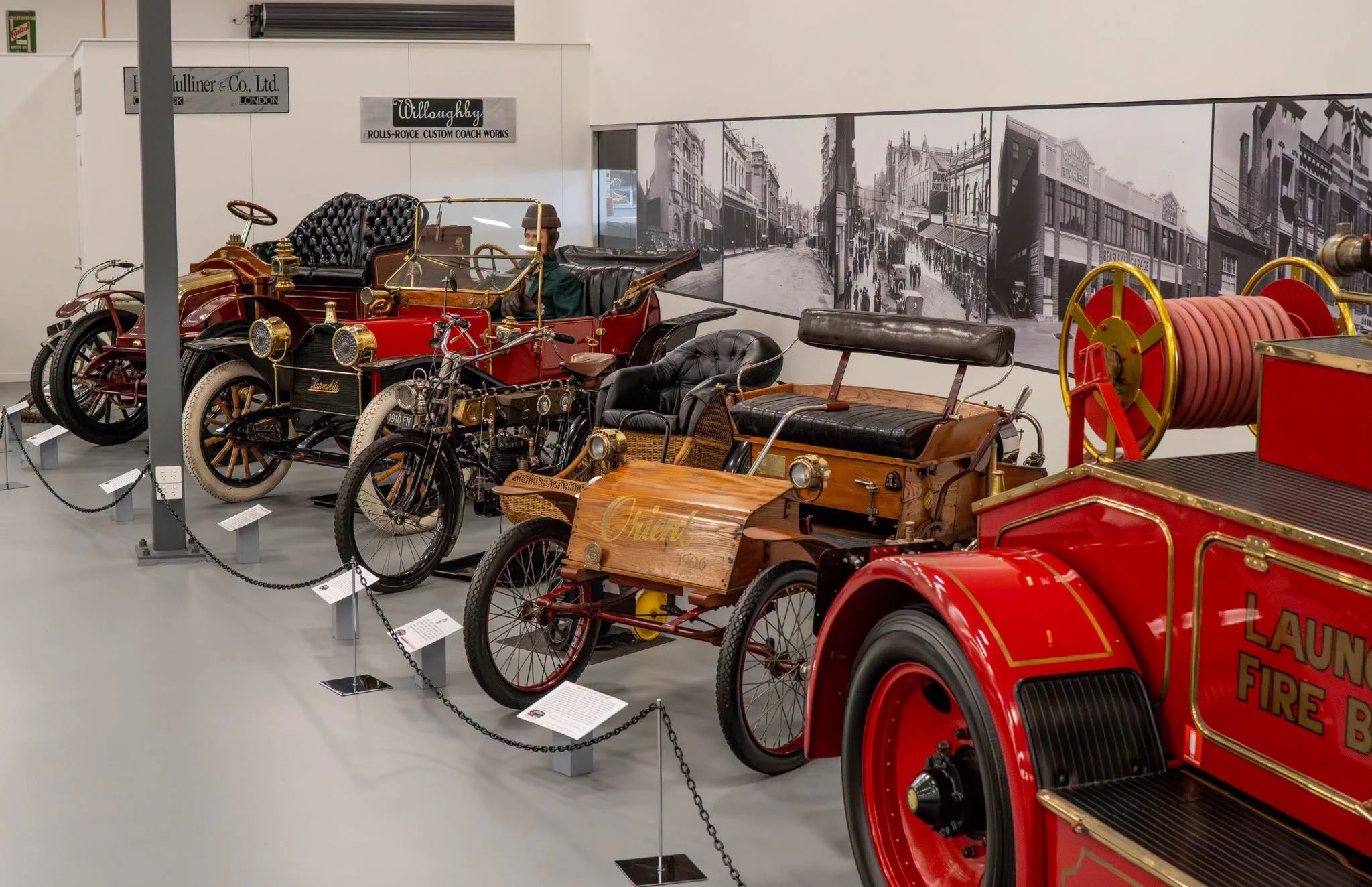
The Dennis on display was purchased in response to Launceston’s expansion and increased building heights. It remained in service until 1977, at which time it was retired. The Launceston Fire Brigade Board entered the motor age In 1920 with the purchase of a Maxwell car fitted out as a “motor hose cart”. In 1929 the Board made two purchase decisions, a 60’ wheeled escape ladder from Merryweather & Sons, London England and a 250 gpm pumper from Dennis Bros, Guilford England (as displayed). Entering service on the 26th of February 1930, the Dennis is powered by a 4 cylinder White & Poppe petrol engine. It features a rear mounted Dennis No. 2 turbine pump and the first live hose reel to be fitted on a LFB appliance. Initially it served as first turnout but after the arrival of a more modern Ford V8 pumper in 1937 it became the carrier of the Brigades wheeled fire escape. In 1983 it was transferred to the Tasmanian Fire Service Museum, total restoration began in 2011 to its original condition in the early 1930s.
1906 Orient Buckboard
Waltham Manufacturing Company was based in Waltham, Massachusetts and produced a variety of vehicles, including bicycles, motorcycles and early automobiles. They sold these designs under the names of Orient, Waltham, or Waltham-Orient. In the pioneering days of early automotive design, lightweight and inexpensive vehicles were popular and often referred to as ‘Buckboards’, a reference to their wooden construction. According to factory records, around 2500 of these vehicles were manufactured between 1902 and 1907. Just 57 exist today, with a total of 3 residing in Australia. The cars were powered by a single-cylinder air-cooled engine, displacing 584cc and producing 4 horsepower. The Orient on display was sold new in Northern Tasmania – bearing the registration number ‘A264’. In 1906, a Buckboard cost 440 US dollars, the equivalent of $21,000 Australian dollars today!
1928 Ford Model A “Lizzie”
FREDERICK SMITHIES O.B.E.
1885 - 1979
An early visitor to Cradle Mountain, Frederick Smithies was instrumental (with others) in having the area declared as a National Park. Fred was an early walker throughout Cradle – Lake St Clair, Frenchman’s Cap, the Lakes District and the West Coast.
He was a member of the Scenery Preservation Board (now National Parks) for many years, a foundation member and for many years President and then Patron of the Northern Tasmanian Alpine Club. Fred was also a Member of the International Stereoscopic Society, The Launceston Art Society, The Northern Tasmanian Camera Club, The Royal Society and The National Trust. Frederick Smithies and his friend Bill King made the first motor vehicle journey from Waratah to Zeehan on a pair of Indian motorcycles in 1924. Fred purchased the Model A Ford on display to replace an ageing Model T, and kept the car until his death in 1979.
1928 FORD MODEL A “LIZZIE”
This 1928 A Model Ford, known affectionately as “Lizzie” throughout many Tasmanian communities, was the first two-wheel drive vehicle to navigate the road up Ben Lomond. In 1932 Frederick Smithies and Lizzie made the first journey by car from the Derwent Bridge to Queenstown. This led to the opening of the West Coast road, which made it only 160 miles from Hobart to Queenstown, however it was still over 300 miles from Launceston and 200 from Burnie. People rallied to have another road built from the Great Lake to Bronte on the Marlborough highway to fill in the missing link. It was Fred and Lizzie who once again proved the journey was possible and the Missing Link road was subsequently constructed. Lizzie with Fred at the wheel also featured in many other improbable journeys into the heart of Tasmania’s wilderness.
1982 Datsun 1200 Utility
It was Ford that kicked off the power wars of the late-'60s, with the V8 powered XR Falcon GT. Not to be left by the wayside Chrysler Australia released its own low-cost, red-hot version of the Valiant. Featuring a high-performance six-cylinder engine and three-speed manual gearbox, the Pacer was aimed firmly at the youth market, previously ignored by Chrysler. Although lacking the V8 power of its rivals the Pacer could race to 180km/h and, at $2798, was a lot cheaper - $400 less than a basic GTS Monaro. The VG Pacer arrived in 1970 powered by a high-performance, two-barrel version of the new Australian made 245cu.in (4.0-litre), six-cylinder Hemi engine. A 'Mod Pack' comprising black bonnet patches and 'spoiler stripes' was available to spice up the exterior.